Showing posts with label creative commons. Show all posts

October 4, 2008

Stop Illicit Internet TV Interception Now!!!


Verimatrix, located in San Diego, CA, has developed software and equipment to keep ITV a.k.a. IPTV, digital video broadcasting (DVB), cable TV, and mobile delivery from being illicitly intercepted by non-paying customers. Don’t you just love this politically correct verbiage?

It uses "forensic watermarking," that resides in the video stream itself, so that a source can be identified in case of leaks. Ohhh -- those BitTorrent kindda leaks in the broadband pipe I assume?

So what does this fancy wording hide?

According the MPAA, worldwide revenue loss for the motion picture industry was more than $18 billion in 2005. In response, a variety of techniques have been developed and are now being deployed to help address content piracy. One of these techniques is called “forensic watermarking,” an off-shoot of digital watermarking of online images, ebooks, web pages, etc.

Verimatrix claims it can securely, robustly and imperceptibly hide serialization information inside your media content. This way you are able to establish a virtual "chain of custody" for your content that accurately identifies the source of unauthorized copies, thus aiding legal actions against the source of such copies.

Unlike encryption, which creates an envelope around content that can effectively secure delivery from point to point, a watermark is embedded in the content itself and remains even after a video is decrypted, decoded and possibly re-encoded to another file.

The most robust watermarks also survive the transition from digital to analog and back. The approach of re-recording an analog playback is called the "analog hole." Robust watermarking can survive this passage through the “analog hole,” enabling identification of unauthorized copies of, for example, camcorder captured material.

I don’t know about you, but I don’t mind my camcorder footage getting mashed-up who-knows-where-and-by-whom. With so much competition, giving away a low-res duplicate of your video is a viable -- I’d say necessary -- way to stay in circulation. NO watermarking, much less “robust watermarking” for that kind of content. However, don’t forget to GET CREDIT FOR YOUR WORK, by requiring Creative Commons Attribution and link-backs from the mash-up artists’ own and syndication sites.

August 31, 2007

Keep This Video!

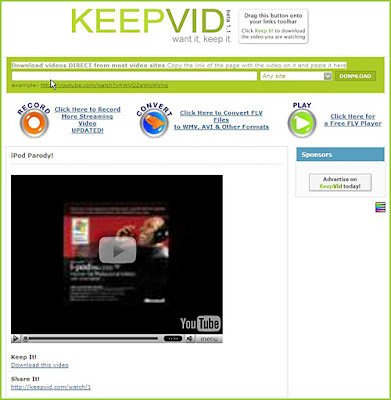
This had to happen ... and it did. Rip ... NO, keep this video ... save this video ... even share this video, courtesy of KeepVid. Its motto: "Want it? Keep it." says it all.

KeepVid


Why should web video be different than music, movies, tv shows, or anything else traversing the net??? Now we can rip off / keep / burn "user-generated" content too. Yes, that's your and my masterpieces (of sorts). And I don't mean book burning. That happens too, even today, to famous authors. So don't feel bad.

Might be a good time to brush up on copyrights and what you can do with the Creative Commons license, I reckon. Do you?

February 3, 2007

Do You Root For Grassroots Media?

That's where the action is going. You must get familiar with Ourmedia if that's where you are headed too.

What do they offer? A lot, like:

* Publishing and storing video, audio, manuscripts, and other media that you create
* Sharing your own and discovering others' independent media.
* Learning how to create citizens' media - that is, yours
* Sharing: RSS feeds, email to a friend, direct link to files from your own site or blog
* FREE storage, sharing & bandwidth forever
* NO ADS!

Downside (as it is):

* Requires an Internet Archive account too
* Slow to upload and view during most of the day
* Keeps your content in its native format. Both good and bad. It doesn't recompress your video - good, but requires viewers to have several different media players installed (not so good)

The Learning Center

My favorite is the Learning Center, which has everything you'd ever want to know about user-created citizens' media. With all the hoopla about copyrights, illegal downloading, Viacom vs. YouTube (see previous post), you DO want to know about your options. One of the best is the Creative Commons license, at work all over the site itself, making it very easy to grasp the concept as well as its execution. Nearly all contributions are shared that way, so other sites can republish bits and pieces from this open-source learning project.

So what can we learn about copyright and the law?

How about:

* Fair use in the digital age
* Online libel and defamation
* What is Creative Commons?
* Filmmakers' best practices in fair use
* Documentary filmmakers, fair use and 'free use'
* Legal issues in creating your podcast
* Release waivers - there is a link to forms
* Terms of Service comparison for video hosting sites
* Publishing public performances

Listen to Lauren Gelman, associate director of Stanford Law School's Center for Internet and Society, as she discusses copyright, fair use, and grassroots media. (You need a media player that works with industry standard MPEG-4 video, to watch.)

Lauren Gelman on copyright and personal media